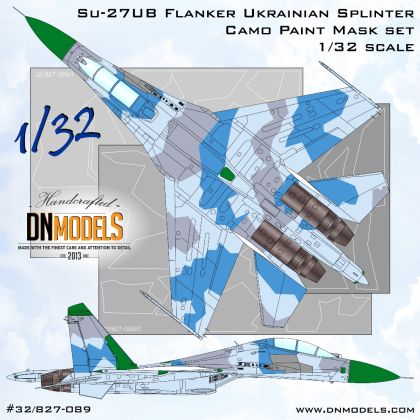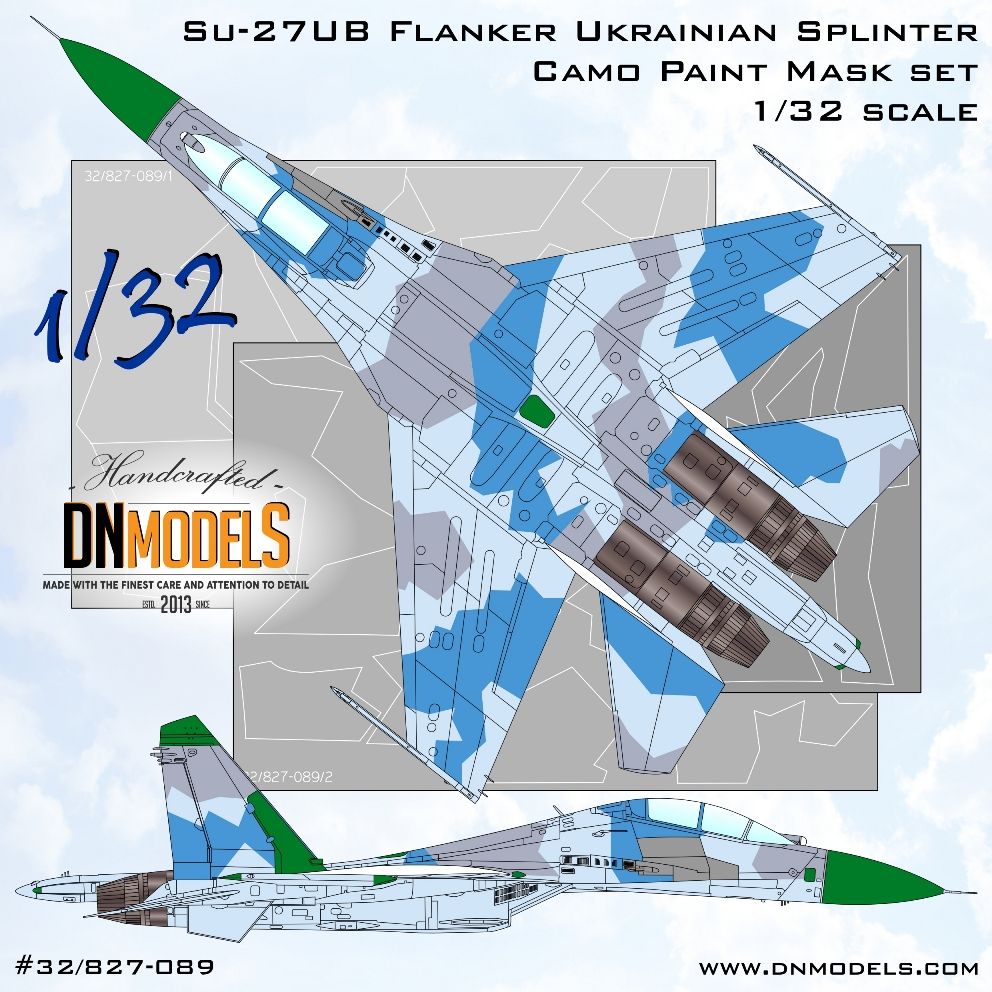
Masks for the splinter camouflage of the Ukrainian two-seat Su-27UB in 1:32 scale. Unlike the curved variant, this pattern rests on sharp broken edges and straight sections.
Responsibility details are not available.
A splinter pattern works on the opposite principle from softly undulating schemes: instead of blurring the outline of the machine it breaks it up into sharply bounded polygons. The eye then cannot join the individual surfaces into a single shape. On a large twin-engine machine with a pair of vertical tail surfaces the effect is striking and at the same time extremely demanding to execute, because every break has to carry on across the edge of a panel without a shift.
The pattern tends to be done in two or three clearly distinguishable tones, so that the edges stand out. Typically it is a combination of a darker blue-gray, a medium gray and a lighter shade, possibly with a very light underside. With this kind of camouflage in particular the contrast between neighboring fields is wanted, so you must not bring the shades as close together as you would for a soft transition. Check the degree of contrast against a photograph of the subject, as individual machines differed.
With a splinter pattern it pays to spray straight down from above and never at an angle, because any blowing under is immediately readable on a straight edge as a loss of sharpness. Press the films down along the whole length of an edge, not only at the corners. And reckon with removing the masks in several stages on a pattern with that number of fields; leave enough time between the individual shades for drying, otherwise a fresh layer will be pressed in while the next film is being stuck down.
Naši poradci a znalci sortimentu jsou připraveni odpovídat na Vaše dotazy (Po–Pá, 8–18 hod).
Zeptejte se na co potřebujete, odpovíme co nejdříve.
Texts from customers in the advice section reflect solely the opinions and views of the customers. MNF trade s.r.o. does not approve or verify customer texts in advance.
There are no questions here yet. Be the first to ask!