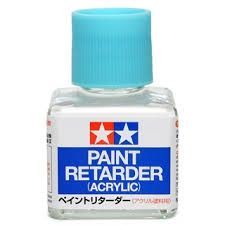
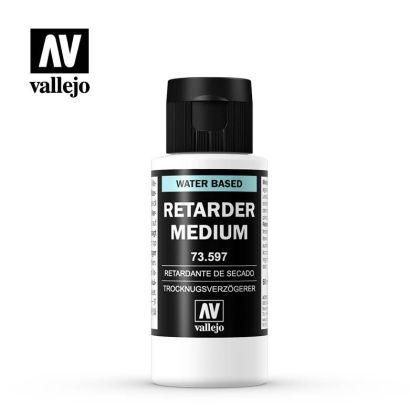
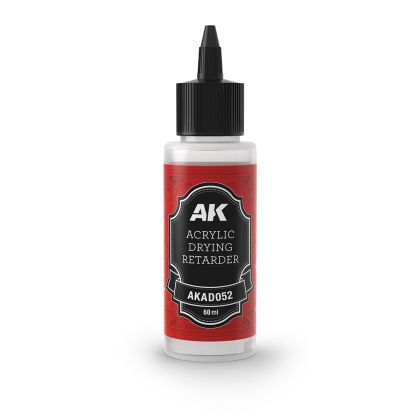
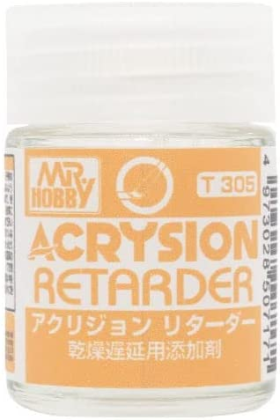
A retarder is an additive that keeps acrylic paint open for longer, both on the model and on the palette. It answers the most irritating habit acrylics have: they skin over so fast that on a larger surface the first brush stroke is dry before the last one lands. With a retarder in the mix the paint can be spread, levelled and blended, and the brush stops clogging with half-dried colour.
Below we set out what separates a retarder from a thinner — they are not interchangeable — and how to dose one so the finish does not stay tacky for days.
Acrylic dries by losing water or solvent to the air. A retarder adds a slower-evaporating component, so the paint stays workable several times longer while curing to the same film it would have without the additive.
This is not thinning. A thinner reduces both viscosity and opacity; a retarder leaves the body of the paint alone and only moves the drying time. Hand-painting a figure or a large fuselage side, that difference is exactly the difference between a smooth surface and visible brush marks.
The main use. With a retarder you can level a surface properly, go back into a stroke to correct it, and still find a wet edge waiting. On figures the same property allows shades to be blended on the model itself, wet into wet between highlight and shadow.
In an airbrush a retarder stops paint drying on the needle and in the nozzle, which is the usual cause of spitting and interrupted spray with acrylics. It earns its place in warm, dry rooms and during fine low-pressure work.
Less is more. A few drops into a paint cup is normally enough; too much leaves the surface tacky for many hours and it can stay permanently soft. Start with the minimum, stir thoroughly and add gradually. Lowering the room temperature and raising humidity slow drying as well.
A retarder belongs to the paint system it was made for — water-based retarder into water-based paints, dedicated mediums into heavier artists' acrylics. Mixing incompatible systems curdles the paint and ruins both the batch and the brush.
The whole auxiliary range is listed under modelling chemicals. A retarder is one of the few additives whose effect is obvious on first use — after which most modellers never brush neat acrylic over a large area again.