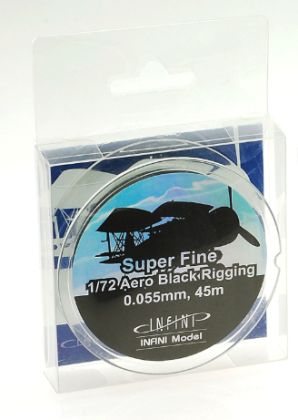
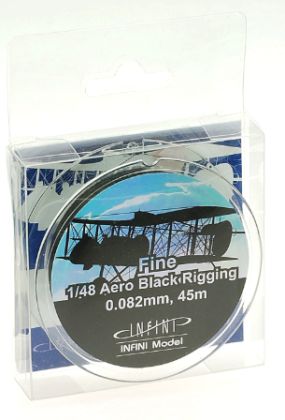
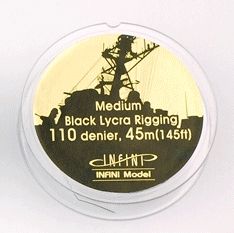
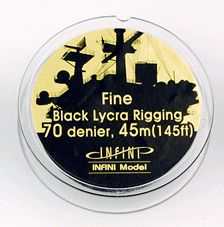
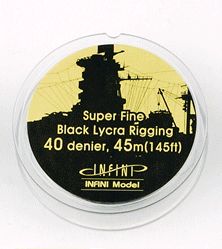
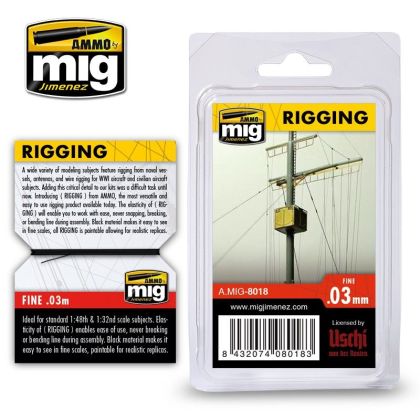
Rigging rope and thread are fine filaments for bracing wires and ship's lines. Sizes start in hundredths of a millimetre, finer than a human hair, and run up to a few tenths. Spools hold around 45 metres, which covers a great many models.
The range separates threads for aircraft bracing in 1:72 and 1:48 from ship rigging for 1:200 down to 1:700, and adds elastic filaments that return to a straight line once tensioned and will not sag after years in a display case.
 ELASTIC RIGGING BOBBIN SUPER-THIN (SUITABLE FOR 1:35 / 1:32 / 1:48 / 1:350)
7.96 €
ELASTIC RIGGING BOBBIN SUPER-THIN (SUITABLE FOR 1:35 / 1:32 / 1:48 / 1:350)
7.96 €
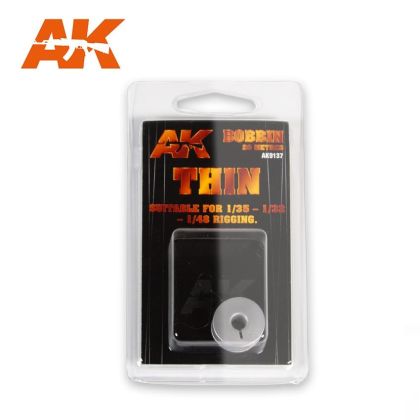 ELASTIC RIGGING BOBBIN THIN (SUITABLE FOR 1:35 / 1:32 / 1:48 )
7.96 €
ELASTIC RIGGING BOBBIN THIN (SUITABLE FOR 1:35 / 1:32 / 1:48 )
7.96 €
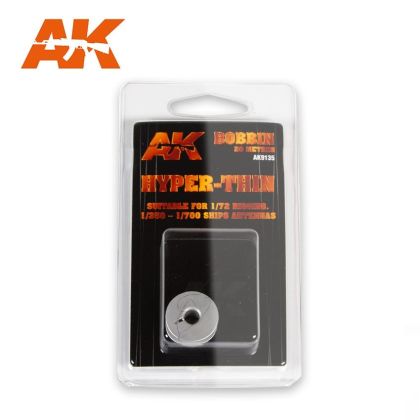 ELASTIC RIGGING BOBBIN HYPER-THIN (SUITABLE FOR 1:72 / 1:350 / 1:700)
7.96 €
ELASTIC RIGGING BOBBIN HYPER-THIN (SUITABLE FOR 1:72 / 1:350 / 1:700)
7.96 €
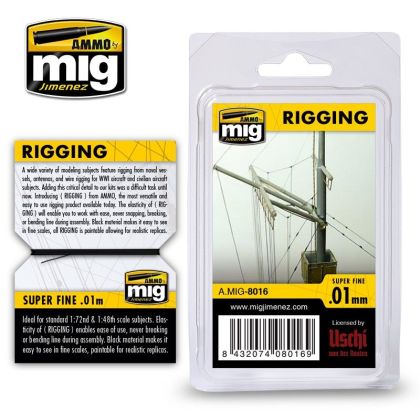 RIGGING – SUPER FINE 0.01 MM
4.76 €
RIGGING – SUPER FINE 0.01 MM
4.76 €
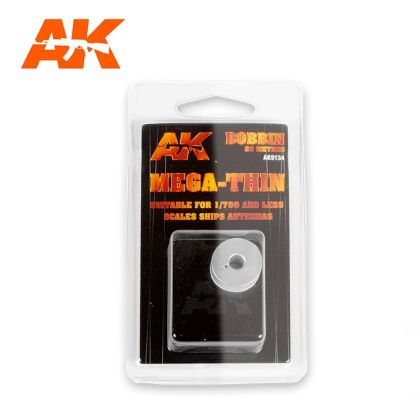 ELASTIC RIGGING BOBBIN MEGA-THIN (SUITABLE FOR 1:700 AND SMALLER SCALES)
7.96 €
ELASTIC RIGGING BOBBIN MEGA-THIN (SUITABLE FOR 1:700 AND SMALLER SCALES)
7.96 €
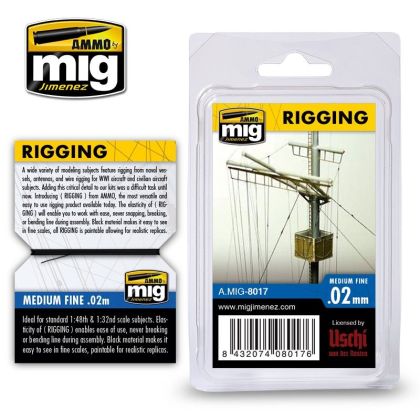 RIGGING – MEDIUM FINE 0.02 MM
4.76 €
RIGGING – MEDIUM FINE 0.02 MM
4.76 €
Wire at these thicknesses is no longer straight and bends at every touch. A filament, by contrast, stays taut between two points, has no memory of a kink and holds a straight line for years in a case. On biplanes and ships this is the detail that decides the model: without its bracing or its rigging it looks unfinished, however good the rest of the work is.
The figure on the spool has to be converted. A 0.03 mm filament reads in 1:72 as a rope about two millimetres across, which is the wire bracing of a biplane. The same filament in 1:350 would be a rope over a centimetre thick, far too heavy for ship's railings. That is why the smallest scales have their own series measured in hundredths of a millimetre.
Elastic thread stretches as it is tensioned and stays taut once anchored, so a bracing wire will never sag, and it forgives small errors in length. Rigid thread keeps an exact length and takes knots and seizings better, but it has to be tensioned correctly the first time.
On aircraft the job is individual straight wires between the wings, anchored into drilled holes and secured with a drop of cyanoacrylate. On ships it is a whole system of lines led through rings and around masts, where chain also comes in for the anchor runs.
Rigging is the classic finishing job on a biplane, so the kits behind it are in the aircraft model kits.