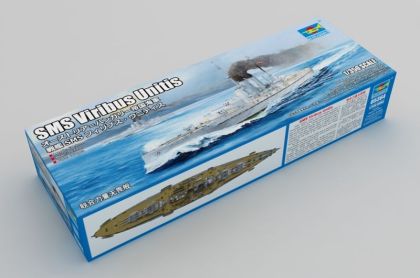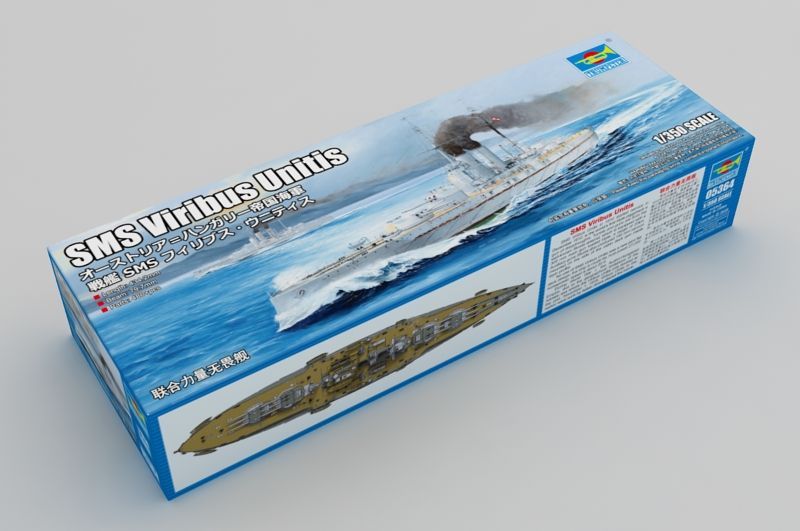
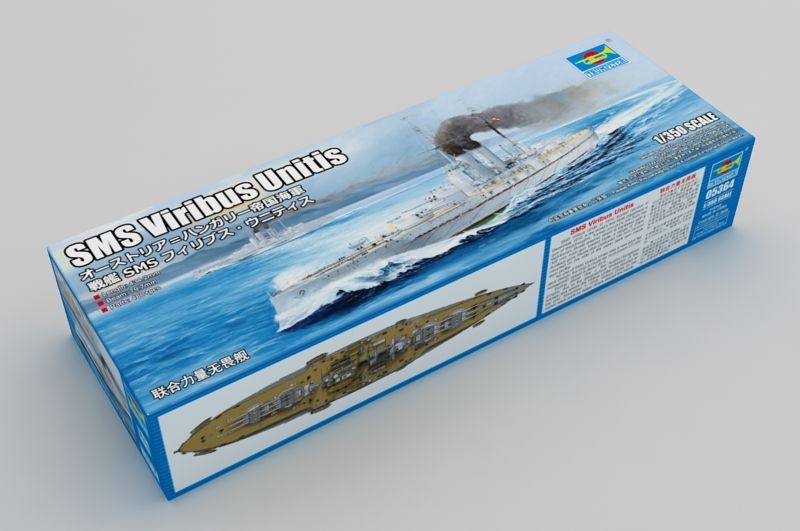
Plastic kit of SMS Viribus Unitis — the first Austro-Hungarian dreadnought battleship — in 1:350 scale from Trumpeter. The manufacturer states over 480 parts, photo-etch, a metal anchor chain and a stand; the finished model measures roughly 43 cm.
Responsibility details are not available.
An unassembled plastic kit of the battleship SMS Viribus Unitis in 1:350 scale from Trumpeter. The manufacturer states more than 480 parts, a hull split into two sections, decks with finely rendered planking, photo-etched parts, a metal anchor chain, decals and a stand. The finished model is roughly 43 cm long and about 8 cm wide. The hull is built as a full hull and set on the stand supplied; a waterline version is not declared by the manufacturer. The tooling is modern, with crisp engraving and fine detail on the superstructure.
Viribus Unitis was the first Austro-Hungarian dreadnought battleship, lead ship of the Tegetthoff class and flagship of the imperial and royal fleet. She was built in Trieste, then a port of the monarchy, and her name, meaning with united forces, was the motto of Emperor Franz Joseph I. The ship carries a strong Central European trace: the main armament — twelve 305 mm guns in four triple turrets — was supplied by Skoda in Plzen, as were the 150 mm secondary guns, and ironworks in the Czech lands took part in the deliveries of steel and armor plate. The crews of the Austro-Hungarian fleet were multinational and Czechs and Moravians served in them as well. The ship also entered history in 1914: after the Sarajevo assassination she carried the bodies of Franz Ferdinand d'Este and his wife Sophie, born Countess Chotek, back to Trieste. The end was no less dramatic. At the end of October 1918 the ship was handed over to the newly formed South Slav state, but as early as 1 November 1918 Italian combat swimmers reached her at Pula on a small piloted craft, fixed a charge to the hull, and after the explosion the battleship capsized and sank. Hundreds of men went down with her, the commander among them.
A ship model is a different discipline from an aircraft — the heart of the work lies in the superstructure, the gun turrets, the small armament, the boats, the railings and the rigging. Glue the hull, sand the seams and prime the surfaces. Paint the decks and the sides while they are still accessible. Join the plastic with thin extra-liquid cement and the photo-etch and the metal chain with cyanoacrylate glue. The ship's paintwork is uniform, so the model lives off detail: a panel wash into the engraving, dry-brushing on the edges, shading of the deck planking. Railings and ladders are the domain of photo-etch on ships in 1:350 — basic photo-etch is in the box, while a complete set of railings is bought separately. Add the rigging last, once the masts and yards are in place.
The model is supplied unassembled and unpainted. Glue, paints and accessories are not included in the package, unless stated otherwise.
Naši poradci a znalci sortimentu jsou připraveni odpovídat na Vaše dotazy (Po–Pá, 8–18 hod).
Zeptejte se na co potřebujete, odpovíme co nejdříve.
Texts from customers in the advice section reflect solely the opinions and views of the customers. MNF trade s.r.o. does not approve or verify customer texts in advance.
There are no questions here yet. Be the first to ask!