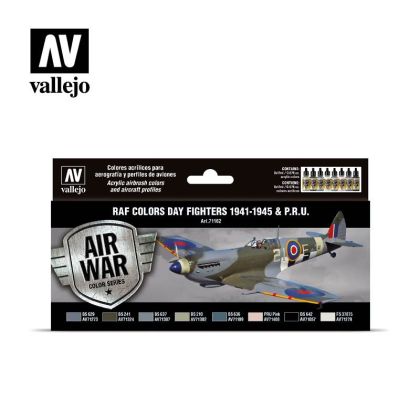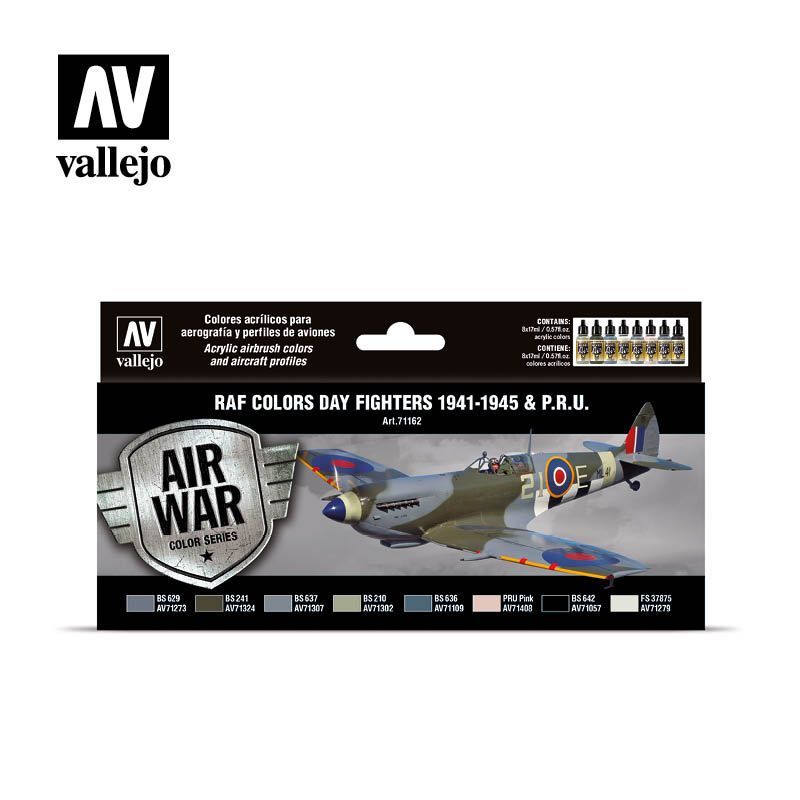


Colors of the Royal Air Force day fighter scheme from 1941, complemented by the characteristic blue of reconnaissance aircraft.
Responsibility details are not available.
From the second half of 1941 the day fighter scheme replaced the older brown-and-green combination and stayed in force until the end of the war. Dark green met Ocean Grey on the upper surfaces, the undersides carried Medium Sea Grey and a light band ran around the rear fuselage. Most of the Spitfires, Typhoons and Tempests you find in kit boxes today wear this look.
The second half of the set belongs to reconnaissance machines. They gave up armament entirely and traded it for cameras and extra fuel, because their defense was altitude and speed. They were given a special deep blue that made them practically invisible above thirteen kilometers. Converted Spitfires and wooden Mosquitos flew in this finish, often hundreds of kilometers behind enemy lines and without escort.
The consistency is aimed at an airbrush and the bottle can usually be emptied into the cup without further work. On the real aircraft the border between the green and the gray was fairly sharp, because it was made through rubber masks. The light fuselage band is masked last.
The cockpit interior, the yellow leading-edge stripes on the wings and the color of the propeller spinner are handled separately. If you are building a machine from the period of the Normandy landings, you will also need white and black for the wide stripes around the fuselage and wings, which were applied in a hurry in June 1944 and often quite carelessly. Brush marks and uneven edges are entirely in place on them.
Naši poradci a znalci sortimentu jsou připraveni odpovídat na Vaše dotazy (Po–Pá, 8–18 hod).
Zeptejte se na co potřebujete, odpovíme co nejdříve.
Texts from customers in the advice section reflect solely the opinions and views of the customers. MNF trade s.r.o. does not approve or verify customer texts in advance.
There are no questions here yet. Be the first to ask!