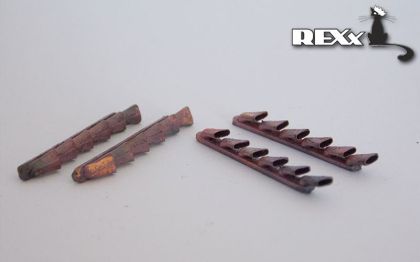
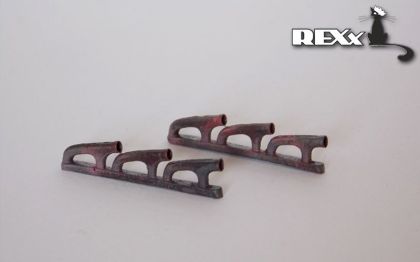
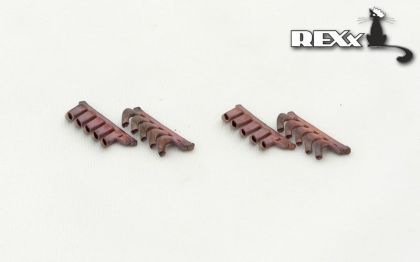
Metal exhausts for aircraft models are one of those changes a visitor notices before anything else. On a piston-engined aeroplane the exhaust stubs sit right beside the cockpit, and a solid styrene moulding with blanked-off outlets simply spoils that view. The metal replacements have genuinely hollow stubs, thin walls and a surface texture that reads as scorched steel once it has been weathered. Sets are made for named types, among them the Mosquito, the LaGG-3 and the Dornier Do 215. How to choose a manifold and how to stain it follows below.
On the real aeroplane the exhaust stubs of a piston engine are thin-walled welded tubes, heat-stained through blue and brown into burnt ochre rust. The kit part has walls over a millimetre thick and outlets that are often moulded shut. A metal exhaust removes that compromise: the stubs are genuinely open, the edges are sharp, and the fine surface texture holds pigment beautifully. A primer coat, a couple of filters and the manifold looks as though it has a hundred flying hours behind it.
An exhaust manifold is unique to its engine and even to the airframe sub-variant, which is why every set carries a precise designation: de Havilland Mosquito B Mk.IV, late-series LaGG-3, Dornier Do 215B. Buy for the exact type and version you are building, because an approximate match will not sit in the cowling.
The range is sorted into 1:32 aircraft exhausts, 1:48 aircraft exhausts and 1:72 aircraft exhausts, with 1:48 the most heavily represented of the three.
Most manifolds locate exactly as the styrene original did, the only difference being that you use cyanoacrylate. Check the description for whether the set replaces the whole manifold or only the tips of the individual stubs.
A well-stained exhaust sells the whole engine bay and lifts the impression of any aircraft model kit. Further brass and steel upgrades are gathered in metal detail sets for aircraft.