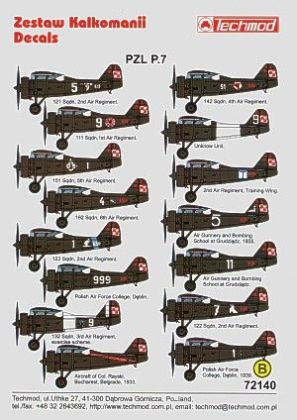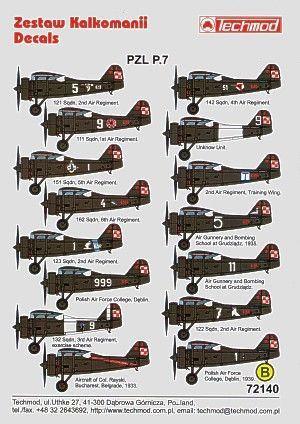
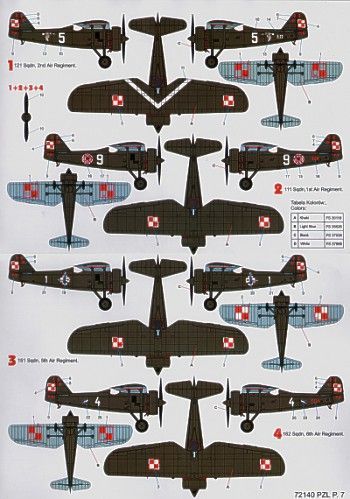
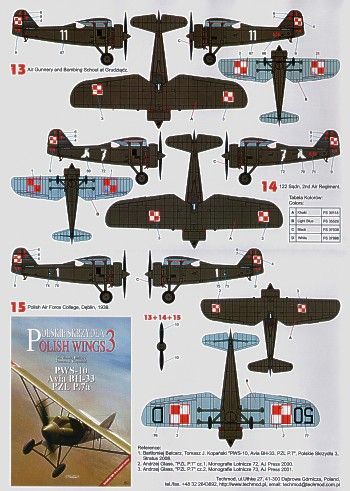
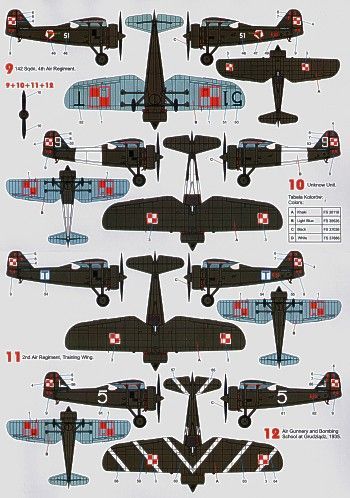
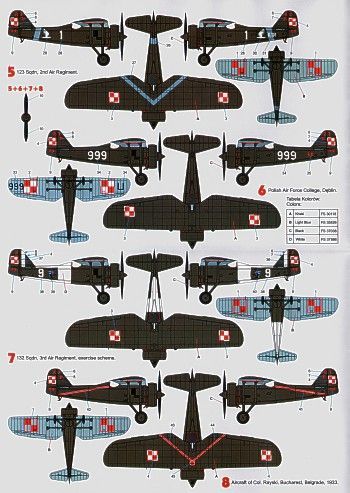
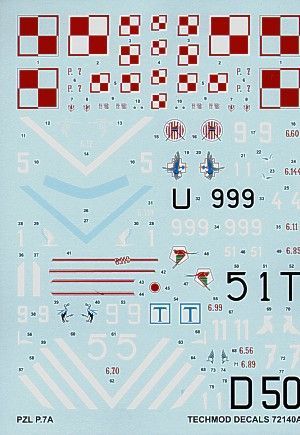
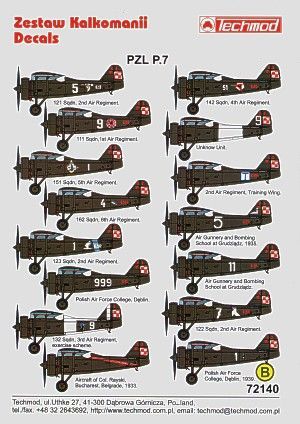
An extensive sheet of markings for the PZL P.7a fighter high-wing monoplane in 1:72. Fifteen variants cover Polish users exclusively, from combat flights through schools to a representative flight of 1933.
Responsibility details are not available.
At the turn of the 1920s and 1930s the Polish design school gave the world the first all-metal fighter high-wing monoplane, whose wing was cranked at the fuselage so that the pilot could see forward and upward without obstruction. The shape is called the Polish wing to this day, and in the first half of the 1930s Poland made it its main fighter aircraft. By 1939 the type was already obsolete, and yet the crews took off in it against a far faster opponent.
The sheet is unusually extensive. Aircraft of the 121st, 111th, 151st, 162nd, 123rd, 132nd, 142nd and 122nd Escadrilles of the 2nd, 1st, 5th, 6th and 3rd Air Regiments are represented, and with them school machines from Deblin and from the gunnery and bombing school at Grudziadz, training schemes and the aircraft in which the commander of the Polish Air Force visited Bucharest and Belgrade.
Most of the machines carried a uniform khaki finish, so what makes the difference between the variants is precisely the markings: the escadrille insignia on the fuselage, the regiment number and sometimes a colored band as well. Before building, go through the whole list and choose according to which insignia appeals to you; the drawing on the sheet is so small that you will not manage without a magnifier and a steady hand.
Naši poradci a znalci sortimentu jsou připraveni odpovídat na Vaše dotazy (Po–Pá, 8–18 hod).
Zeptejte se na co potřebujete, odpovíme co nejdříve.
Texts from customers in the advice section reflect solely the opinions and views of the customers. MNF trade s.r.o. does not approve or verify customer texts in advance.
There are no questions here yet. Be the first to ask!