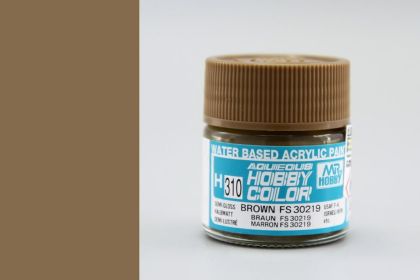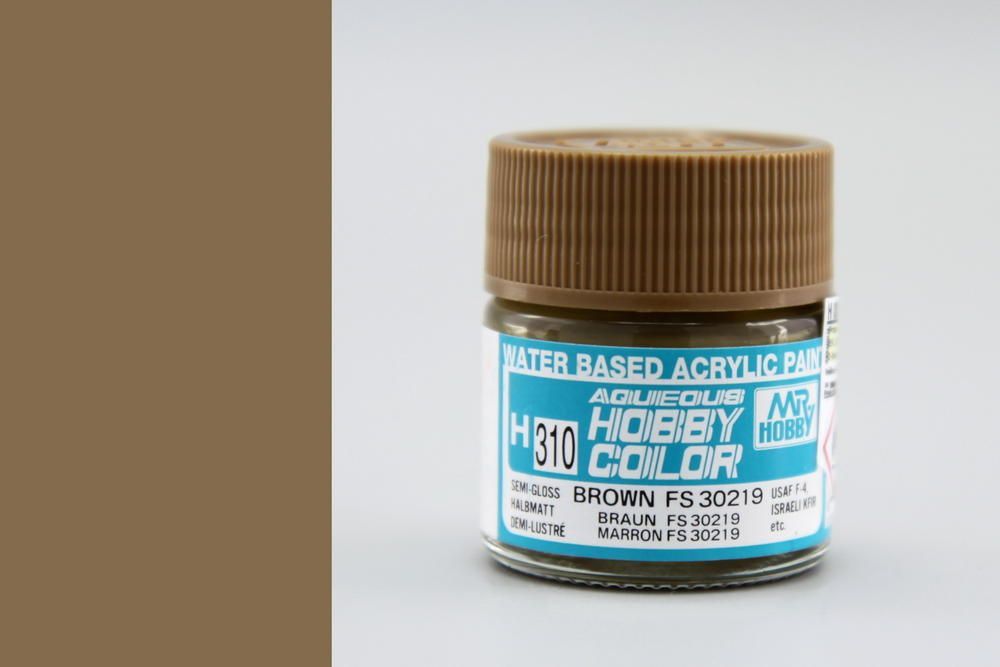

A brown tone listed in the US standard under the number 30219, in a water-based modeling acrylic. Ten milliliters of paint for spraying and for hand painting alike.
Responsibility details are not available.
The four-color camouflage the US Air Force applied to aircraft deployed over Vietnam was built on two greens, one brown and a light gray for the undersides. It was this brown that formed the lightest of the upper fields in the pattern, and in period photographs you can pick it out by the irregular lobes running from the wing root back toward the tail surfaces.
The scheme was introduced in the middle of the 1960s and survived on transport and attack types for many years after the fighting ended. The same brown also appears on ground vehicles of the same period and on aircraft containers, so the jar suits modelers of both fields and is used up faster than one would expect.
A quality synthetic brush will handle smaller areas without visible strokes, as long as you thin the paint only slightly and work quickly in one direction. The second coat comes only once the first has dried completely, otherwise it starts to dissolve under the bristles and tears into lumps. Larger areas are still better sprayed; hand painting leaves patches on them that show up under the final clear coat.
Before applying the decals, coat the area with gloss varnish so that no air is trapped under the film and the edges do not turn white. The matte clear coat comes right at the end, after the washes and after the exhaust staining above the wing has been painted in.
Naši poradci a znalci sortimentu jsou připraveni odpovídat na Vaše dotazy (Po–Pá, 8–18 hod).
Zeptejte se na co potřebujete, odpovíme co nejdříve.
Texts from customers in the advice section reflect solely the opinions and views of the customers. MNF trade s.r.o. does not approve or verify customer texts in advance.
There are no questions here yet. Be the first to ask!