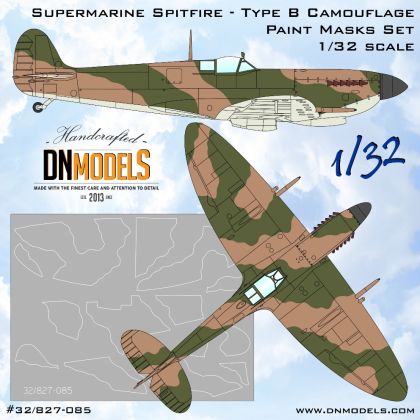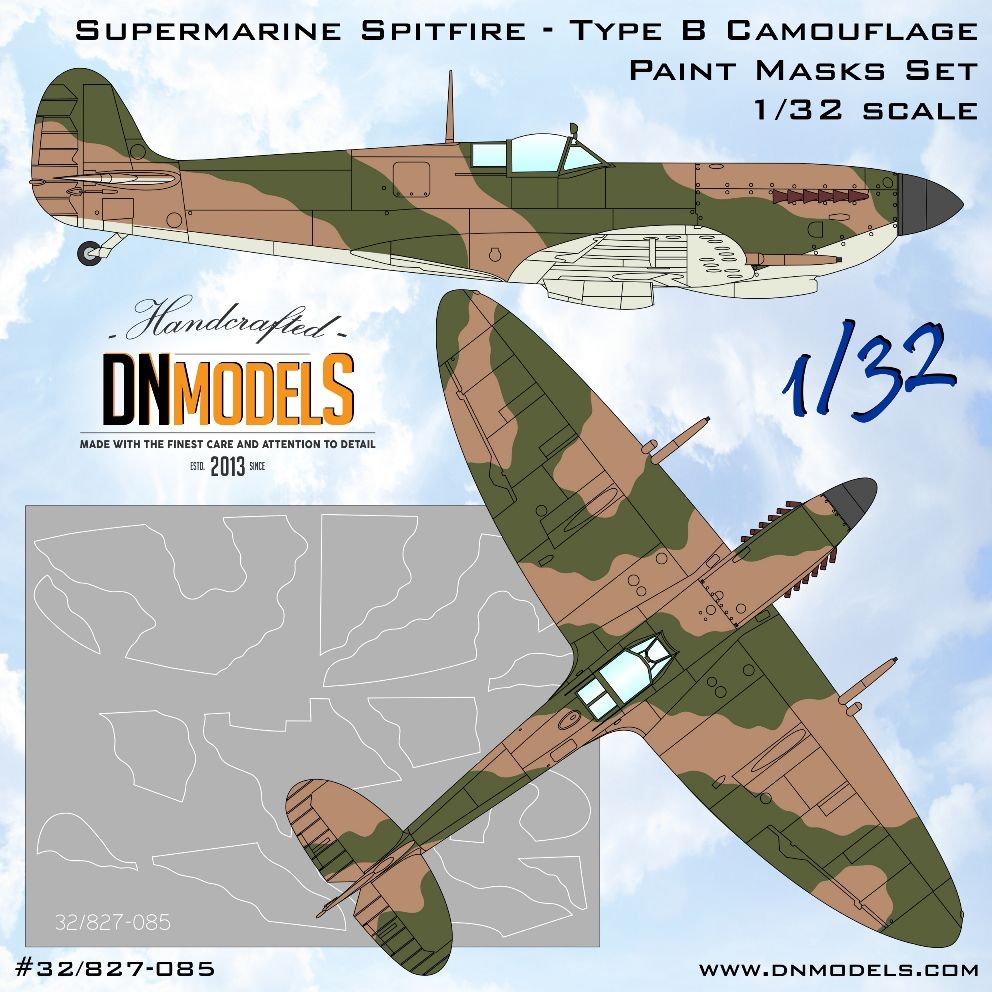


Masks for spraying camouflage pattern B onto a Spitfire model, 1:32 scale.
Responsibility details are not available.
British day fighters of the late 1930s wore a two-color upper finish in two precisely prescribed layouts. They were designated pattern A and pattern B, and one was the mirror image of the other. In production they alternated piece by piece, so neighboring aircraft on the line had their patches swapped, and over an airfield this gave an impression of more variety than there actually was. When it turned out that this only complicated assembly, the ministry canceled pattern B and had all airframes finished uniformly. That is exactly why it is attractive to modelers: it applied briefly and so it marks machines from a particular period.
The boundary between the two shades runs across the wing, the fuselage and the tail surfaces in one continuous curve, and nobody will repeat it by hand the same way twice. The pre-cut pieces copy the course of the line as it was prescribed and also take care that the pattern lines up at the transition between wing and fuselage. In this enlargement, where the wing spans over twenty centimeters, every hesitation of the hand shows up as a visible ripple.
The pattern gets swapped for its counterpart. Both layouts look the same at first glance, and the difference lies only in which half carries which patch. The builder looks at a period photograph without checking which side it was taken from, and lays the pattern on reversed. The finished model then wears a finish that machine never carried. Before you reach for the gun, lay the pieces out dry, step back and compare them with a drawing from above.
Naši poradci a znalci sortimentu jsou připraveni odpovídat na Vaše dotazy (Po–Pá, 8–18 hod).
Zeptejte se na co potřebujete, odpovíme co nejdříve.
Texts from customers in the advice section reflect solely the opinions and views of the customers. MNF trade s.r.o. does not approve or verify customer texts in advance.
There are no questions here yet. Be the first to ask!