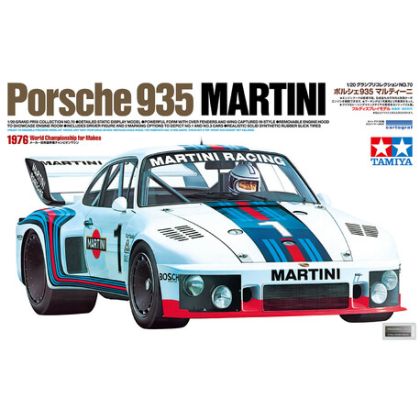
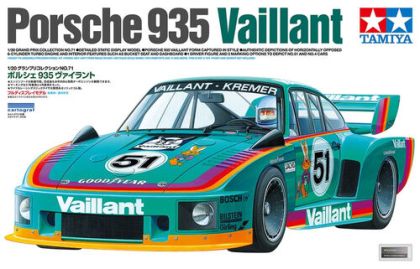
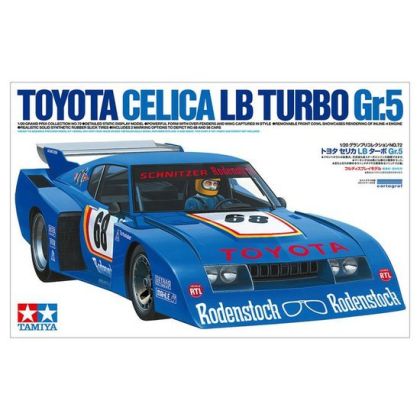
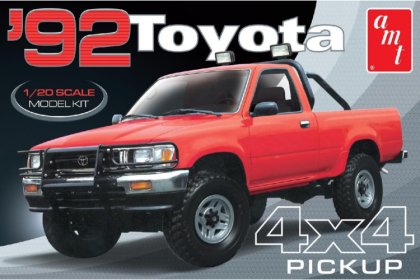
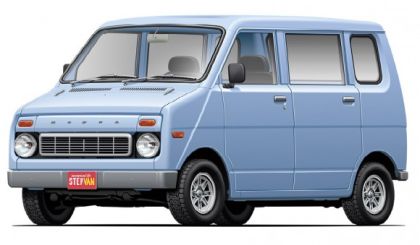
The 1:20 format owes its existence to single-seat racing kits, and the same logic carries over to the closed-wheel cars gathered here: a little larger than mainstream 1:24, which leaves room for finer chassis and interior work. Expect circuit machines with race numbers on the doors, Japanese coupés, and the occasional pickup or microvan. It is a smaller, more collector-minded selection than the big scales, and it pairs perfectly with a shelf of single-seaters in the same size.
The scale took root with Japanese racing-car kits, because a single-seater at 1:20 comes out big enough for a detailed engine and small enough to display. Closed-wheel subjects followed: Group 5 silhouettes with vast arches, touring cars, and a run of Japanese road subjects. A finished car measures roughly 22 cm, only slightly more than 1:24, but you see the difference immediately in the wheels, the brakes and the dashboard.
Race subjects bring multi-panel bodywork, aerodynamic add-ons and generous decal sheets full of sponsor markings, so expect to mask multi-colour schemes. Road subjects are simpler to assemble and make a sensible first project in the scale, because they let you concentrate on the paint finish instead of on part count.
Large race markings want a polished gloss coat underneath, helped along with a setting solution. On a matt surface, air stays trapped under the film and the carrier silvers. A final clear coat sinks the markings into the paint so they stop looking like stickers.
If single-seaters are also on your bench, stay at 1:20. A circuit car and a Grand Prix machine side by side tell the story of one motorsport era in a way no mixed shelf can, and the wheels and detail parts you buy will serve both.
1:20 is the home ground of the 1:20 formula car model kits kept in their own section. A wider spread of road and racing subjects sits in 1:24 and 1:25 car model kits, and the whole branch is gathered under car model kits.