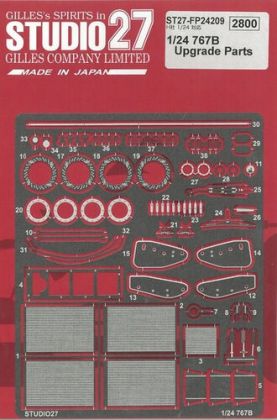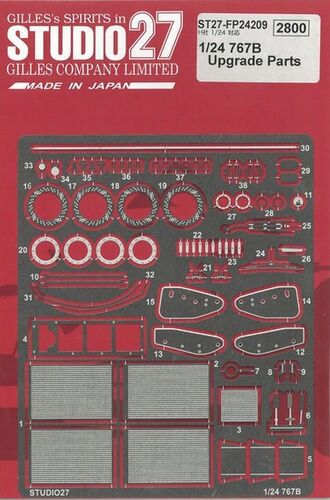
1:24 Mazda 767B - Upgrade Parts (for Hasegawa Kits) is a Studio27 photo-etched detail set for the rotary prototype out of which the winning 787B grew. It is not a kit — it is a set of additional parts for the Mazda 767B kit from Hasegawa, which you already have to own.
Responsibility details are not available.
A Studio27 photo-etched detail set in 1:24 scale. It is NOT a kit and not a finished model — it is a set of additional parts for the Mazda 767B plastic kit from Hasegawa. The basic kit is not in the package and has to be owned. Note that this set is the only one in the range cut for a Hasegawa kit, not Tamiya — the photo-etched fret is punched to the outlines of one particular kit and will not fit a model from another maker. And beware of a second mix-up: the 767B is not the 787B. They are two different cars and their photo-etched sets are even intended for kits from different makers — Studio27 also makes the set for the winning 787B (for the Tamiya kit).
The Mazda 767B is a Group C rotary prototype from the end of the 1980s and the direct predecessor of the Mazda 787B, which won the 24 Hours of Le Mans in 1991. The 767B itself never won Le Mans — but on the grid at La Sarthe it held its own among the European elite and at best finished inside the overall top ten. It was from its concept and its rotary engineering that the later winner grew: the 787B is an evolution of the 767B, with a new generation of the four-rotor engine. That makes the 767B the car out of which the winner grew — and for a collector who wants the whole development line of Mazda, it is simply a necessity. The era of Group C is among the finest that racing sports cars have known: closed prototypes of enormous power, but with rules built on limited fuel consumption — whoever wanted to win had to be able to go fast and save fuel at the same time, which was a hard-fought contest between Japanese and European works teams alike.
A Group C prototype is threaded with large intakes and radiators that are clearly visible from the outside. A molded plastic grille is only an engraving — a pancake you cannot see through. A photo-etched mesh, by contrast, is thin and see-through, exactly like the real thing, and the difference shows at first glance. The same goes for the seat belts in the open cockpit: photo-etched buckles with webbing look like a real belt. Honestly about the practice, though: the parts have to be bent (an etch bender is a great help), they are glued with cyanoacrylate glue and many a plastic detail has to be sanded away first — and that you will not get back. The set is therefore intended for more experienced modelers equipped with tweezers and a magnifier. Do not forget that an endurance prototype should be glossy — clear varnish and polishing compound matter just as much to the final impression as the photo-etched parts.
This is an additional set, not a model. The basic kit, the glue, the paints and the tools are not included in the package, unless stated otherwise.
Naši poradci a znalci sortimentu jsou připraveni odpovídat na Vaše dotazy (Po–Pá, 8–18 hod).
Zeptejte se na co potřebujete, odpovíme co nejdříve.
Texts from customers in the advice section reflect solely the opinions and views of the customers. MNF trade s.r.o. does not approve or verify customer texts in advance.
There are no questions here yet. Be the first to ask!