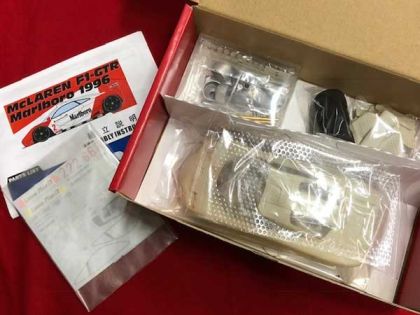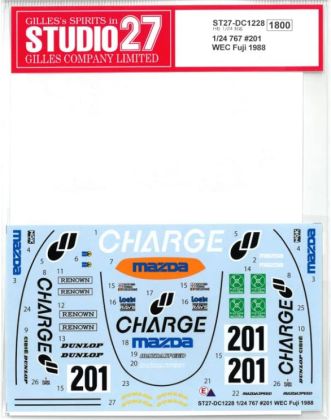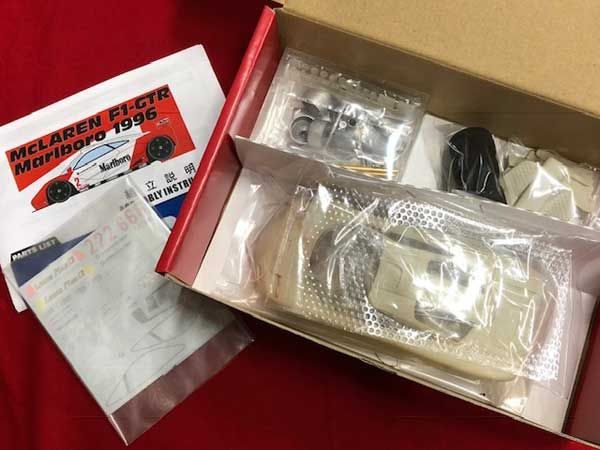
1:24 McLaren F1-GTR Zhuhai Marlboro 1996 Multimedia Kit is a multimedia kit from the Japanese Studio27 — a resin body supplemented by metal parts and decals. It is not injection-molded plastic; the build is intended for experienced modelers and collectors.
Responsibility details are not available.
A multimedia kit in 1:24 scale from the Japanese maker Studio27, which specializes in racing cars in short runs. Its basis is a body cast in resin, supplemented by metal parts and a set of decals for one particular car from the Chinese Zhuhai circuit in the 1996 season. It is not an injection-molded plastic model — it is worked with differently and is intended for advanced modelers. The main reason for reaching for a kit like this is simple: practically nobody makes this particular car in this particular specification in plastic. A short run, sought after by collectors.
In the 1990s the McLaren F1 was the fastest production car in the world and it held that record for a number of years. It was powered by a BMW V12 of roughly 6.1 liters and it had a unique cabin arrangement — the driver's seat is in the middle of the car, with two passenger seats slightly behind it at the sides. Three places, the driver in the middle.
The racing GTR version did not keep anyone waiting: it won the 24 Hours of Le Mans on its very first start in 1995, and did so against purpose-built prototypes. In 1996 the cars then started in the BPR Global GT series, whose closing event was run at the Zhuhai circuit in China. The team entered there in a one-off Marlboro livery — a red and white combination that made it one of the most memorable appearances of the F1-GTR of all. It is that visual icon that the kit captures.
The most important step of all: wash the parts first. Mold release agent stays on resin castings — a greasy film that cannot be seen. Without washing (warm water, detergent, a soft brush, then left to dry thoroughly) the paint will not grip and in time it peels. It is by far the most common reason a resin build ends in disappointment.
It also holds that resin cannot be glued with cement for plastic — it does not react to it at all. Cyanoacrylate glue is used, ideally with an activator. The parts have no pins or sockets as a plastic kit does, so everything is dry fitted, fitted together and sanded. Cut the casting blocks off with a saw, never with nippers — resin is brittle and will crack.
Resin dust is harmful to health. Sand wet and use a respirator, not a dust mask. Flexible sanding sponges that follow the shape come in handy on the curves of the body. Apply primer before painting, then spray the body with an airbrush and seal it with a gloss clear coat after the decals.
The model is supplied unassembled and unpainted. Glue, paints and accessories are not included in the package, unless stated otherwise.
Naši poradci a znalci sortimentu jsou připraveni odpovídat na Vaše dotazy (Po–Pá, 8–18 hod).
Zeptejte se na co potřebujete, odpovíme co nejdříve.
Texts from customers in the advice section reflect solely the opinions and views of the customers. MNF trade s.r.o. does not approve or verify customer texts in advance.
There are no questions here yet. Be the first to ask!