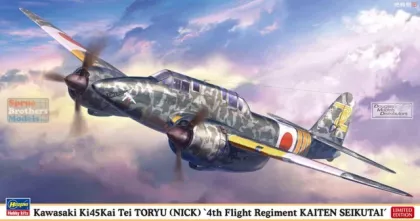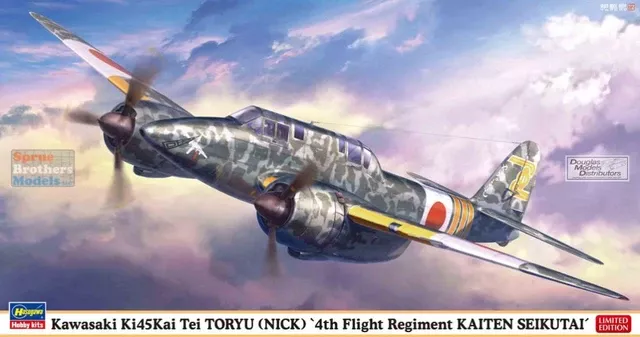
Hasegawa 1:48 Kawasaki Ki-45 Kai Tei Toryu (Nick) — 4th Flight Regiment is an injection-molded plastic kit of the Japanese twin-engine heavy fighter that was used, among other roles, as a night fighter against American B-29 bombers.
Responsibility details are not available.
An injection-molded plastic kit of the Japanese twin-engine heavy fighter Kawasaki Ki-45 Kai Tei in 1:48 scale. The boxing is aimed at aircraft of the 4th Flight Regiment — one of the units that operated the Ki-45 in the defense of the Japanese home islands. The designation Kai Tei corresponds to the fourth production modification of the type (KAId in Western usage), that is the late, night-fighter form of the aircraft. The kit is plastic, with decals for that scheme.
The Ki-45 Toryu — the name means dragon slayer — was a Japanese twin-engine heavy fighter; the Allies gave it the code name Nick. It was originally designed as a long-range escort fighter, but it found its real calling elsewhere: in the defense of Japanese airspace against night raids by B-29 bombers. The Kai Tei version was adapted for that with heavy forward armament — a pair of 20 mm Ho-5 cannon in the nose and a 37 mm Ho-203 cannon in a ventral gondola, plus a defensive machine gun in the rear of the cockpit. And yes: on Tei version aircraft a pair of obliquely upward-firing 20 mm cannon also appeared behind the cockpit — the same principle the Germans used under the name Schräge Musik: the night fighter slid in beneath the bomber and fired into its unprotected belly. It is only fair to add that this was a later addition, not equipment on every aircraft built. The crew consisted of the pilot and a second man; the Ki-45 was slower than single-engine fighters, but it carried armament that a single-seater could not have lifted.
A twin-engine aircraft means more work on alignment: always dry-fit the engine nacelles and their mounting to the wing before you glue anything — an error in the angle of a nacelle shows on the finished model. The cockpit is long and clearly visible, so it is worth investing time in it even after the fuselage is closed; mask the glazing. Use liquid cement for plastic and even out the surface with a primer. Late Japanese aircraft were usually dark green on top and bare metal or light gray below — on a model in this scale, do the edge between them with an airbrush and a slight softening rather than a hard transition. Spray a gloss clear coat before the decals and a matte one after them; pick out the panel lines with a capillary paneliner and do not overdo it — the Ki-45 were not airshow machines, but they were not wrecks either.
The model is supplied unassembled and unpainted. Glue, paints and accessories are not included in the package, unless stated otherwise.
Naši poradci a znalci sortimentu jsou připraveni odpovídat na Vaše dotazy (Po–Pá, 8–18 hod).
Zeptejte se na co potřebujete, odpovíme co nejdříve.
Texts from customers in the advice section reflect solely the opinions and views of the customers. MNF trade s.r.o. does not approve or verify customer texts in advance.
There are no questions here yet. Be the first to ask!