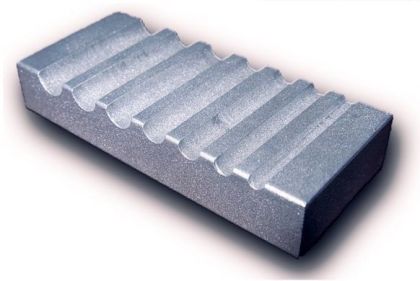
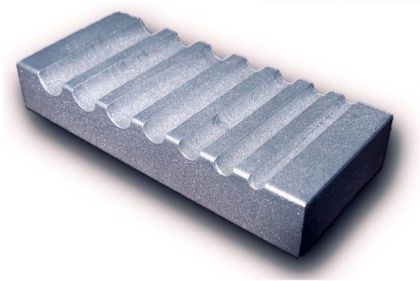
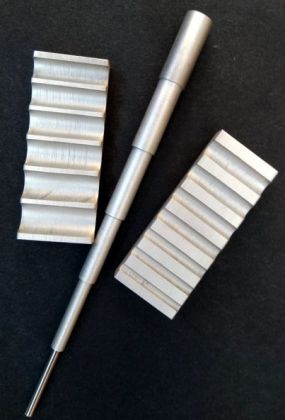
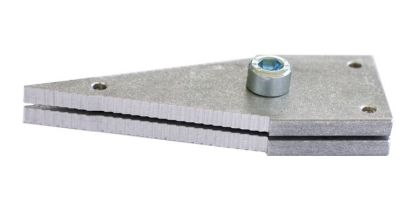
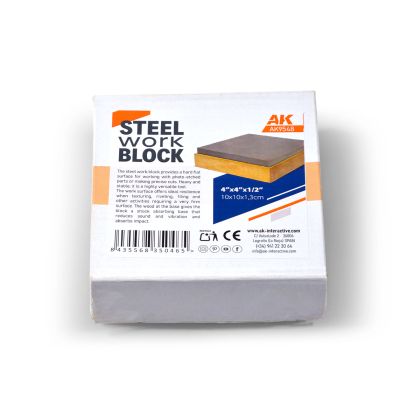
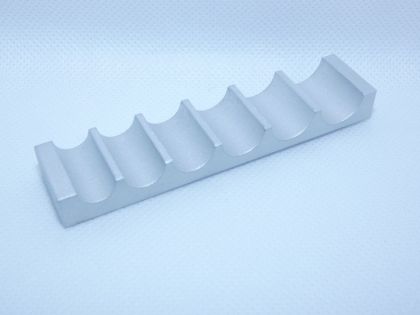
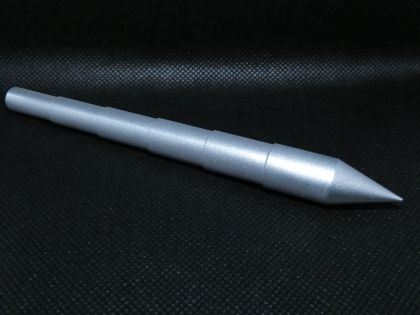
Beyond the bender and the pliers there is a whole family of jigs that brass and wire work cannot do without. It includes rolling bars that turn a flat fret into a tube or an arc, rollers with several stepped diameters for a repeatable radius, wire bending jigs with shaped grooves, steel backing blocks for forming and planishing, and scissors made specifically for cutting thin metal sheet without buckling it. None of them replaces a bender; they handle the shapes a clamping bar was never meant to produce.
A fold along a sharp edge is only the beginning. A model also needs cylinders, arcs, cones, eyes and small wire structures. A bender with a clamping bar will not produce any of those — you need a tool that forms the material progressively, and a support solid enough to work against.
Two or three rollers with an adjustable gap. The fret is drawn between them and repeated passes bring the radius down until a clean cylinder appears with no kink. Rollers with stepped diameters give a repeatable result, so ten identical parts really are identical.
These have shaped grooves and pins that bend wire to the same form every time. They suit grab handles, brackets, eyes, aerials and bracing. When a series of identical parts is needed, it is the only sensible route.
A hard, flat surface to form, true and planish against. It is used together with small hammers and for flattening a buckled fret. A timber bench absorbs the blow; a steel plate returns it into the material.
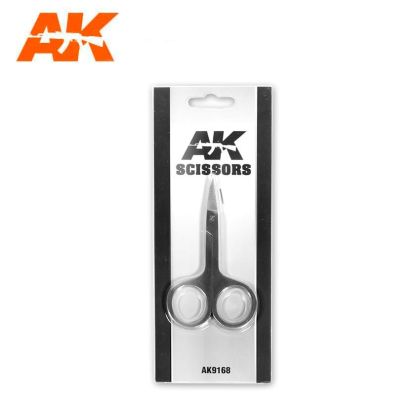
Short, sharp jaws that cut a fret straight instead of twisting it. Ordinary scissors distort metal as they close and you lose the straight edge for good.
The same rule applies as to folding: gradually and in small steps. Bring a radius down over several passes rather than in one go, or the fret kinks. Metal work-hardens as it is formed, so repeated bending in one spot ends in a crack. Fix finished parts with cyanoacrylate and handle them with tweezers.
For rolling heavier profiles and tubing, the tools in bending tools and jigs are also worth a look.