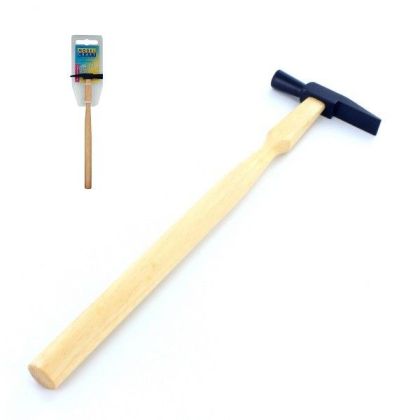
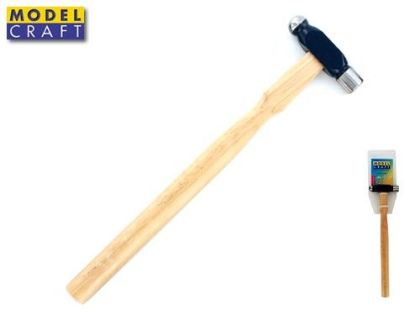
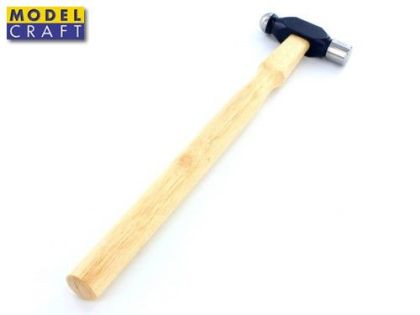
A hammer on a modelling bench looks illogical until the day you need one. Then it turns out that nothing else will drive a pin into timber, straighten a bent metal profile, push out a peg or planish a shape into sheet. The category offers small hammers with a brass head that leaves no marks on the workpiece, watchmaker's hammers light enough for a precise tap, and guided nail setters that keep a tiny pin from bending as it goes in. None of them is a tool you reach for every evening, but when a pin has to go into timber, nothing else does the job without splitting it.
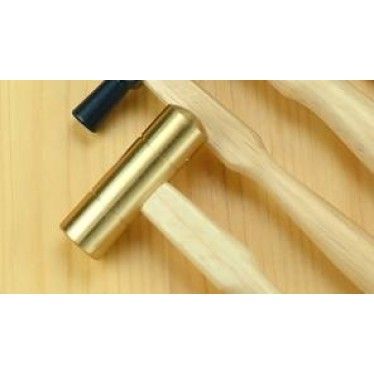
Mass and head material. A normal steel hammer transfers far too much energy into a small part and leaves a bruise on metal. Modelling hammers weigh tens of grams, have a short handle, and often a head softer than the workpiece — brass deforms itself first and so protects sheet, tube and the edge of a profile.
The softer head spreads the blow and leaves the surface intact. They are used for dressing metal profiles, seating a pin and carefully planishing sheet on a backing plate. Work on a hard support, never on a timber bench top, so the energy stays in the workpiece.
Very light with a narrow head. They suit work that needs many weak, accurately placed blows — easing a bend out gradually, or working with a tiny rivet.
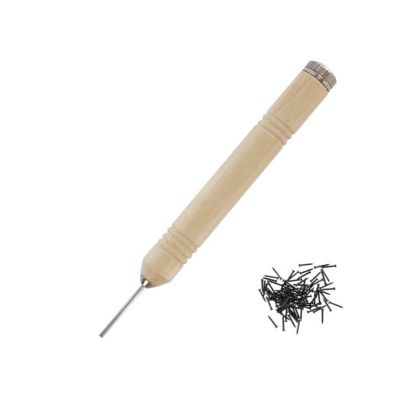
A tool that guides a pin or nail and lets you press it home. Used on timber structures, on ship models and anywhere a real nail head should be visible rather than a painted dot. The sleeve holds the pin upright so it cannot bend, and a magazine of small nails saves hunting for one in a tin.
Three rules hold. The blow should be short and delivered from a low lift — energy is added by the number of taps, not by the swing. The workpiece must lie flat on a solid support, or it simply rings and nothing moves. And with a nail or pin it pays to drill the hole first: the material then does not split and the pin goes in straight, which on thin timber strip is the difference between a finished part and a crack.
For a bend without a blow, a tool from bending tools and jigs is the better answer, because it forms the shape under steady pressure.