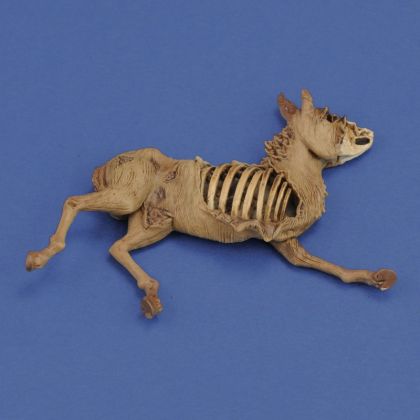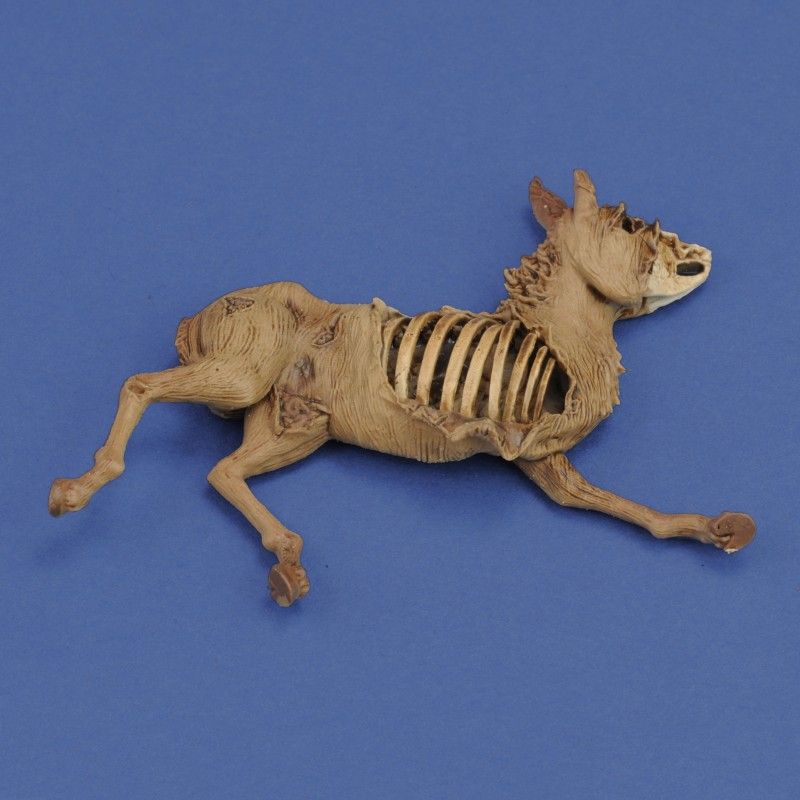
A casting of a dead donkey in 1:35, intended as an expressive element for a war diorama.
Responsibility details are not available.
The motorization of the Second World War tends to be overrated. Mountain units, artillery batteries and supply columns in the Balkans, in Italy and on the Eastern Front still leaned on draft and pack animals, because to many positions there simply was no road for a truck. Where there were animals, their bodies were left behind after an ambush or a shelling as well.
A diorama works when it tells the viewer something. A fallen animal at the side of the road says without words what happened here a moment ago, and at the same time it leaves the main figures to do other work. That is exactly why motifs of this kind appear in competition work on the themes of Italy 1944, Crete 1941 or the retreat from the Caucasus.
An element like this is used sparingly. It comes off best partly covered, for instance behind a wrecked cart, in a ditch or under a strip of tarpaulin, so that the scene stays a narrative and does not slide into gratuitous gruesomeness. It goes well with spilled cargo, a torn harness or wheel tracks in mud.
A donkey's coat is gray-brown with a markedly lighter belly and muzzle. A completely matte surface helps the convincing effect, along with fine drybrushing in the direction of the hair and dust settled on the upper side of the body. Avoid a sheen, which would turn the casting into a plastic toy at once, and add earth at the point of contact with the ground instead. The hooves and the exposed teeth hold a bone tone, not pure white.
Naši poradci a znalci sortimentu jsou připraveni odpovídat na Vaše dotazy (Po–Pá, 8–18 hod).
Zeptejte se na co potřebujete, odpovíme co nejdříve.
Texts from customers in the advice section reflect solely the opinions and views of the customers. MNF trade s.r.o. does not approve or verify customer texts in advance.
There are no questions here yet. Be the first to ask!