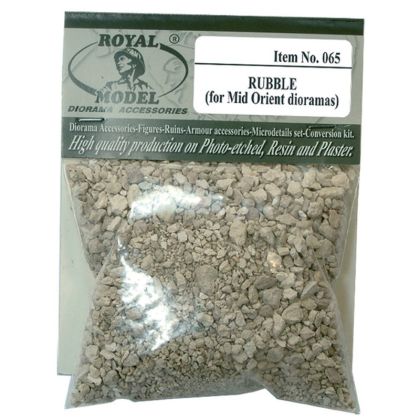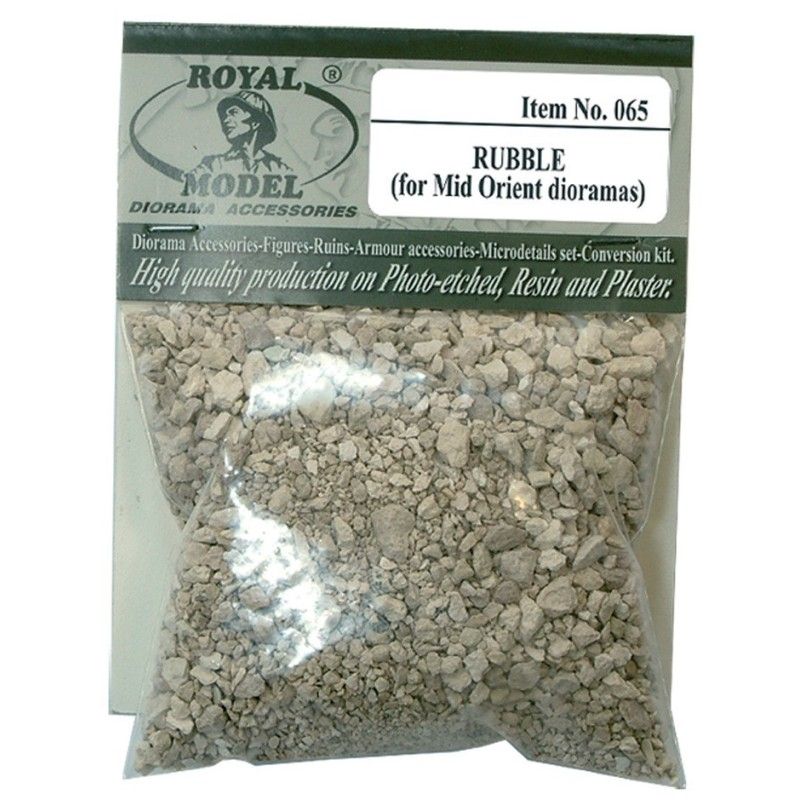
Scatter material for depicting rubble and ruins on a diorama.
Responsibility details are not available.
Rubble is what makes a combat diorama believable. Broken masonry never spreads evenly: it piles up at the foot of walls, spills out of breached openings and lies thinnest in the open. Scatter material makes that difference quick to achieve without modeling piece by piece, whether you are building a destroyed house, a courtyard after a hit or just the edge of a road.
First lay out where the rubble will lie and scatter it in place dry. Once the layout looks right, wick thinned PVA glue with a drop of detergent into the material, which helps it flow, or seat the individual larger pieces with super glue. Let it dry completely and only then paint and soil the area. The coarser pieces belong at the bottom and at the foot of a wall, and the fine dust on top and around, so that the transition to a clean surface is not abrupt.
Sort the grain beforehand according to the scale of the diorama: what looks like a brick in a larger scale is a boulder in a smaller one. Never paint rubble in a single shade, as variety is what makes the result; once it is dry, unify it with a dark glaze and bring out the highest edges with a dry brush. Finally, complete the area with pigment or fine dust so that the rubble blends optically with the terrain and does not look like a heaped-up pile.
Glue, paints, pigments and a base are not part of the delivery, unless stated otherwise.
Naši poradci a znalci sortimentu jsou připraveni odpovídat na Vaše dotazy (Po–Pá, 8–18 hod).
Zeptejte se na co potřebujete, odpovíme co nejdříve.
Texts from customers in the advice section reflect solely the opinions and views of the customers. MNF trade s.r.o. does not approve or verify customer texts in advance.
There are no questions here yet. Be the first to ask!